War as the toughest test of engineering. CZ Podcast with Aerorozvědka
Military subjects have always interested me, and a decade ago I was devouring one military book after another. Tastes change as you get older, and books from other genres started finding their way onto my shelf.
In recent years, unfortunately, much of my reading on military affairs has come from the news about the war in Ukraine. I regularly read the battlefield updates in Deník N.
If one thing has had an enormous impact on how the fighting unfolds, it’s drones. Forget the image of war as large infantry assaults backed by columns of armored vehicles. That was mostly what we saw at the start of the war. Then drones took over and changed the rules practically everywhere. In the air, on the ground, and at sea. Infantry and armor are still there, of course, but how they’re used has had to change fundamentally.
In episode 358 of CZ Podcast, we hosted Aerorozvědka, a group that develops, manufactures, tests, and delivers drones to the Ukrainian front.
Before recording, we spent most of our time figuring out how to honor the guys’ request to remain anonymous. Looking back, after hearing a few stories about getting drones into combat positions, I can hardly blame them. You can never be too careful.
What I took away from the podcast
Scalability is the mantra
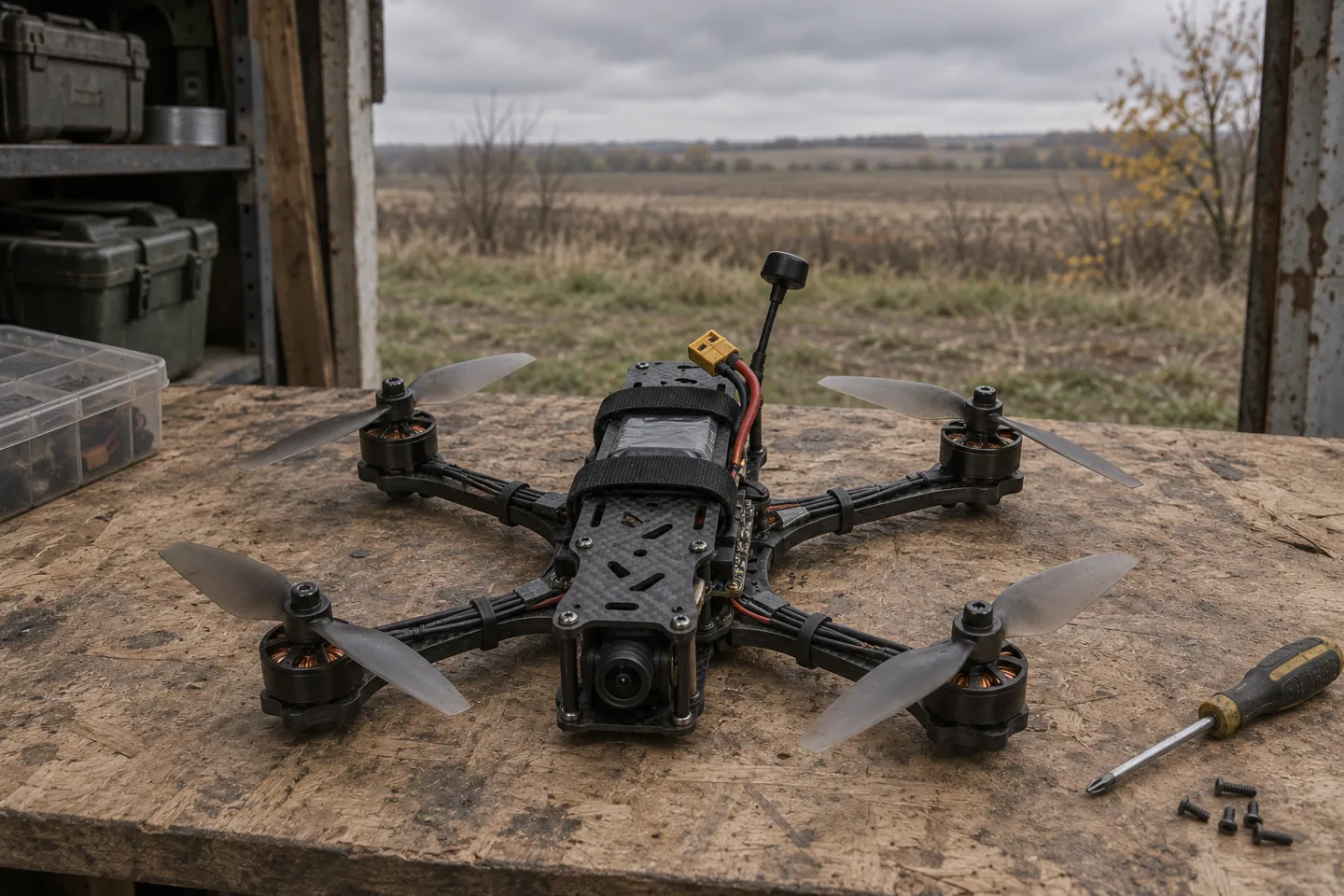
And it has two dimensions. In Aerorozvědka’s approach to building drones, cost and simplicity come first. Ideally, you want something soldiers can fix on the front line with some duct tape and a 3D printer.
The second dimension is manufacturing itself. You have to be able to make huge numbers of drones, ideally from readily available parts, at a price you can afford.
This is where Aerorozvědka’s approach runs up against what some companies are trying to do. Build the most technologically advanced drone they can. The result is often an expensive, complicated product that’s so costly to lose that it ends up being kept off the front line. To the guys, that’s exactly the antipattern they’re trying to avoid.
On the podcast, they illustrate it with a story about a commander who, after losing an expensive drone, sent a soldier into no man’s land to retrieve it. The alternative was for the soldier to pay for a new one out of his own pocket. So instead of the drone protecting the soldier’s life, the soldier risks his life for the drone. Absurd, but it shows why cost and simplicity matter well beyond the economics.
Cheap, fast manufacturing comes with one catch. It depends on a supply of components from China. At first glance, that seems far from ideal when you’re making drones for the Ukrainian front.
The guys explain that it’s a deliberate trade-off between cost, manufacturing speed, and security risk. Without cheap, readily available Chinese components, it would be much harder to make drones in the quantities needed. They also use relatively simple parts, which they consider less of a security risk than complex, closed systems.
The risk is still there, but in their case the trade-off makes sense. Getting enough working drones to the front quickly matters more than eliminating every risk.
A simple equation gives you a sense of the numbers. Take the average daily losses among the orcs and multiply by the number of FPV drones it takes per orc. It’s a rough approximation, of course. Even so, we’re talking about thousands of drones a day. And that may still be a conservative estimate.
Suddenly it’s obvious why Aerorozvědka prioritizes cost, simplicity, and scalability over both technological perfection and the pursuit of independence from China at any cost.
Developing drones works like a startup
Developing, testing, improving, and delivering drones to the front isn’t all that different from running a startup. In many respects it’s exactly the same.
Strip the product back to what it needs to scale. Test it quickly, get it into users’ hands, gather feedback, and keep iterating based on actual combat experience.
As little unnecessary complexity as possible. Short development cycles. Feedback straight from the people using it.
As the guys described how they develop drones, I kept thinking that this is exactly how a good startup should work. With one crucial difference. Here, people’s lives depend directly on how quickly you develop and how well your work holds up.
OODA. Speed determines who survives
The Russians know what they’re doing, and their engineering in particular shouldn’t be underestimated.
Both sides keep shortening their OODA loops. OODA stands for Observe, Orient, Decide, Act. You observe what’s happening, make sense of it, decide what to do, and act.
Sooner or later, every new weapon gets a countermeasure. Then comes a response to that countermeasure. The time it takes for each of these innovations to reach the battlefield keeps getting shorter.
In ordinary engineering, a faster OODA loop gives you a competitive advantage. On the front line, it can determine whether you survive.
On the podcast, for example, we talk about drones that hang from high-voltage power lines and wait for their prey, and drones fitted with shotguns that get past protective nets.
And this may be the most interesting part. The advantage goes to whoever reacts faster and adapts to the opponent, even when someone else has better technology at that moment.
Starlink versus Kometa. Why is GPS so easy to jam?
For me, this was one of the most technically interesting parts of the podcast.
First, it helps to distinguish between two things that often get mixed up. Satellite communications and satellite navigation.
Starlink primarily provides satellite internet. It gives you a data connection that can, for example, carry video from a drone or let you control one remotely. Its advantages include satellites in low Earth orbit, directional antennas, and a relatively robust communications link that is harder to jam than an ordinary radio link. It can still be jammed.
GPS tells you where you are. The problem is that the signal comes from satellites about 20,000 kilometers away. By the time it reaches a receiver on Earth, it’s so weak that a stronger radio signal nearby can drown it out fairly easily.
There are two different problems here. With jamming, the receiver loses the ability to receive the navigation signal properly. With spoofing, it receives false information and may think it’s somewhere else entirely.
Incidentally, we discussed this a decade ago in CZ Podcast #152 – Hacking geolocation services. Our guest was leading Czech cryptanalyst Tomáš Rosa, who told us, among other things, a story about GPS jamming by the US Navy and the chaos that followed in a harbor.
If you’re interested in how someone can jam GPS or trick a receiver into reporting a false position, I also recommend his talk GPS signal spoofing over the air. It shows how long we’ve known about some of the technological problems that now shape the battlefield in Ukraine.
That’s where Kometa comes in.
Kometa is a Russian system designed to make reception of satellite navigation signals like GPS or Russia’s GLONASS more resilient. It uses an array of antennas and signal processing to suppress interference and keep navigation working even in an electronic warfare environment.
Starlink and Kometa address different problems. Starlink mainly keeps communications working. Kometa helps keep navigation working. Both illustrate how much electronic warfare now matters on the battlefield.
Navigation without GPS and different approaches to development
The guys also explain the options when Starlink is unavailable or satellite navigation can’t be relied on.
We talked about inertial navigation, which uses sensors to track motion, and odometry, which estimates changes in position from measurements of movement. These methods can work without a continuous satellite signal, though errors can build up over time.
We also talked about drones controlled over fiber-optic cable. The cable replaces the radio link between operator and drone and comes with its own constraints.
It was also interesting to compare the economics of the different solutions and how the two sides approach drone development. I’ll leave that to the podcast itself.
Surprisingly, AI doesn’t rule the battlefield. Yet.
Neural networks are, of course, used for computer vision, audio processing, and target recognition and tracking. AI also helps guide drones in the final phase of an attack. For example, once an operator designates a target, the drone can continue even if it loses contact.
Systems that independently decide whom to attack and when are still uncommon on the battlefield.
The aim is to hand over as many combat tasks as possible from people to robots.
Drones and ground robots already do all sorts of jobs. Delivering supplies, evacuating the wounded, conducting reconnaissance, and taking part in combat.
Given how fast technology is changing on the front line, you have to wonder how much longer that “yet” will hold.
War as a battle of engineers
What I find most interesting is how quickly the war also became a battle of engineers.
So much depends on how quickly you can develop, build, test, and change something. And on how readily you can throw away a solution that worked yesterday and is obsolete today.
Scalability, rapid iteration, short feedback loops, and ever-shorter OODA loops. It all sounds like the stuff we deal with every day in software engineering.
Here, the stakes are immeasurably higher.
Listen to CZ Podcast #358
I’d definitely recommend giving this episode a listen. You’ll find it on Spotify or SoundCloud.
I’d also recommend one of my older articles here on Dagblog, What a foot soldier and a code monkey have in common.
And before I forget, you’re invited to the recording of the CZ Podcast Christmas episode at Apify.
Related articles
Related CZ Podcast episodes
- CZ Podcast #152 – Hacking geolokačních služeb
Tomáš Rosa on jamming and spoofing GPS signals. · Czech audio