Organization design, sons of the Reich on the payroll, and Will Smith not Black enough
Looking through last week’s articles, I realized I’d mostly been reading about nontechnical topics. I did find one technical piece, though, on organization design. We develop dependencies between teams, and that’s always a problem because planning gets complicated and a team doesn’t control the entire problem it’s trying to solve. You can also look at it from the other side. Suppose a single service has five products, like Google with Maps, Docs, email, and so on. If each handled sign-in separately, the teams would have everything under control, and it would be awful for users. Nick Tune describes this dilemma in Product-aligned vs Capability-aligned Organisation Design. If you’re dealing with a similar problem, how to organize your organization, read it.
TL;DR;
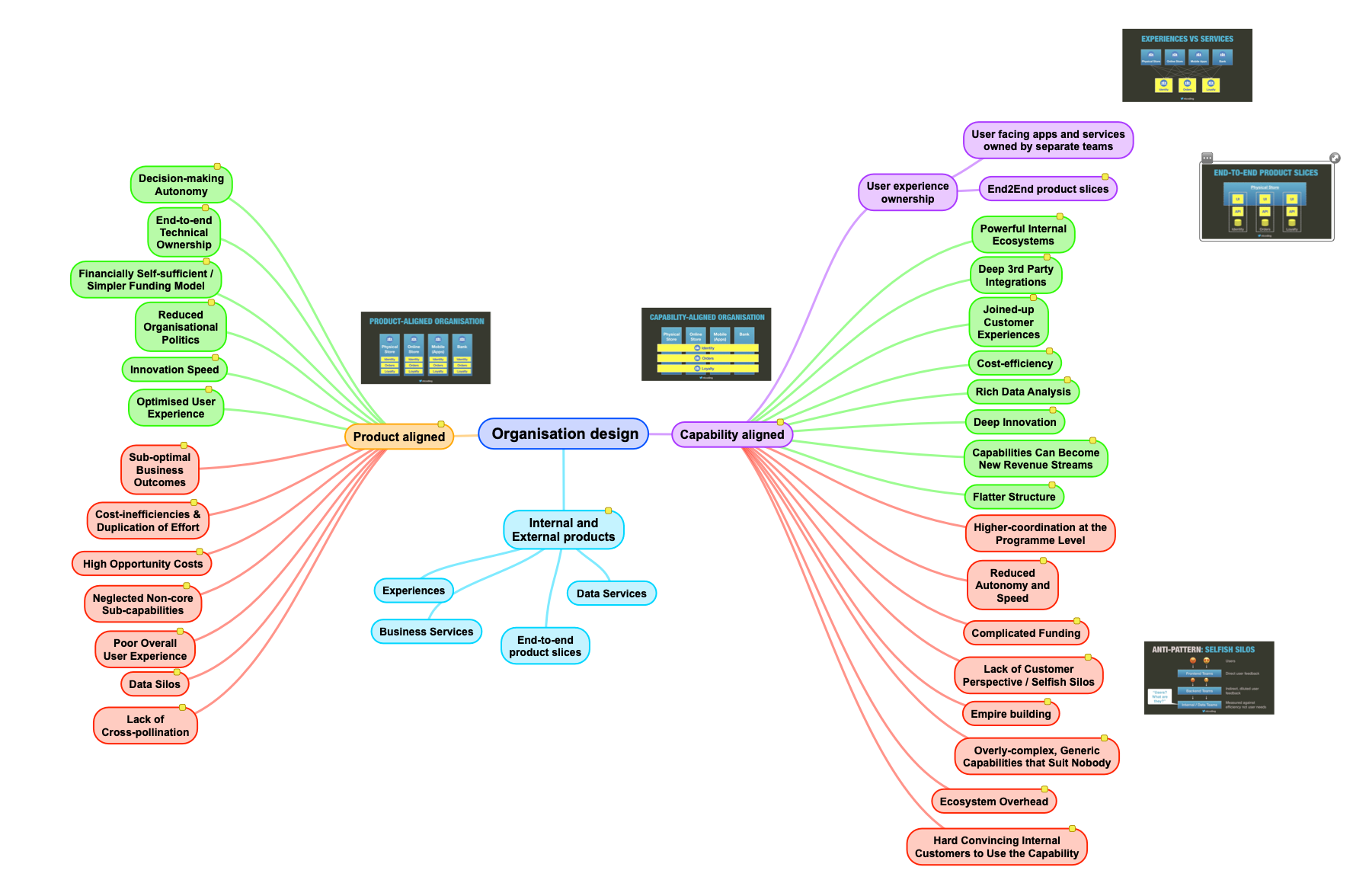
A combination of the two approaches works best, as the mind map I drew shows. Notice how evenly matched the strengths and weaknesses of the two approaches are.
As you can probably tell, these choices aren’t mutually exclusive. You can apply the different patterns in different parts of your organisation and combine them for best effect.
Last week I enjoyed Lukáš Křečan’s What kind of brief do I need?. He described what I’d written about in my piece on lemmings, and it also follows nicely from organization design and how organizations work internally.
I came to the conclusion that a good brief needs exactly these two parts:
1. A description of the problem we need to solve.
2. A business metric to measure whether we’ve solved it.
It sounds simple, but we just can’t seem to manage it. Let’s take it step by step. We keep getting solutions in place of problem descriptions. Instead of “the customer doesn’t know what to do on the registration form,” we get “make the Submit button red.” Instead of “we need to cut spending in the ministries,” we get “build a government district in Letňany.”
Then comes the unsurprising realization of why it’s hard to switch to thinking this way.
The human mind is a problem-solving machine. It’s so good at it that when there are no problems, it makes some up so it has something to solve. It’s terribly hard to stick to describing a problem. It’s difficult to say “this is my problem.” It comes more naturally to say “this is what I want.” It’s hard to say “I don’t understand this form,” so we say “you should swap these two fields.” Everyone wants to contribute an idea, so sticking to the problem description is genuinely hard even if you persuade people it’s necessary.
Odds and ends
- We recorded CZ Podcast episode 208 on writing documentation and training. By the way, Jirka Kosek must have some kind of radar. He immediately found out we’d been talking about him in connection with DocBook.
- Sometimes it pays to be an employee https://www.seznamzpravy.cz/clanek/jako-zamestnanec-se-stal-miliardarem-ted-vlcek-avast-povede-coby-novy-sef-68091
- The idea of Will Smith being “not Black enough” amused me. Franta Fuka commented on what’s happening in Hollywood https://video.aktualne.cz/dvtv/malo-cerny-will-smith-jsou-to-silene-zpravy-hollywood-resi-z/r~13b08992443211e9b6a9ac1f6b220ee8/
- Elite Czech Ranger: He trained in the American mountains and fought Islamists in places the allies couldn’t reach. He shares Václav Havel’s idea of securing sovereignty through NATO membership https://archiv.ihned.cz/c7-66512380-qrorq-ae42eee69ab42dd
- Bad times are returning to Europe. Fervent love for Jews frightens me and sends chills down my spine, says Rabbi Sidon https://denikn.cz/86290/do-evropy-se-vraci-spatne-casy-desi-me-zanicena-laska-k-zidum-mam-z-ni-mrazeni-v-zadech-rika-rabin-sidon/
- Germany still pays compensation to Nazi collaborators, Belgian lawmakers say. Among those who receive pensions for victims and Wehrmacht soldiers are 94 Czechs. You could take it to mean that two lightning bolts on a helmet and a blood type tattooed in the armpit are hardly a major issue for the German pension system https://denikn.cz/89245/nemecko-dosud-plati-odskodneni-i-kolaborantum-s-nacisty-tvrdi-belgicti-poslanci-mezi-prijemci-penzi-pro-obeti-i-vojaky-wehrmachtu-je-i-94-cechu/?ref=dnapp
Have a good start to the week. If you want to get my newsletters regularly, click Follow on dagblog.cz. The archive is here.
Related articles
Related CZ Podcast episodes
- #261 · Leadership
On leading people and teams. · Czech audio