SpringSource Application Platform
And here it is. SpringSource, the company behind the Spring Framework, announced a beta release of its own application platform. The traditional way to use the Spring Framework, or applications built on it, was always to have an application server provide services. Now SpringSource is offering a complete stack built around the Spring Framework, OSGi and Tomcat, which it calls the SpringSource Application Platform, or simply the platform below.
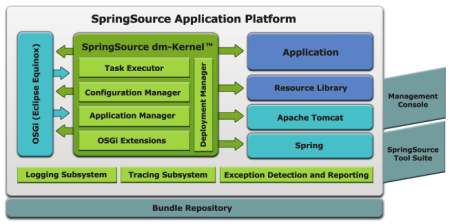
The main difference between the platform and an application server is deployment granularity. With a traditional application server, you deploy a WAR, EAR or EJB module. Because the platform is built on OSGi, you can deploy individual application modules or other units you decide to organize into bundles.
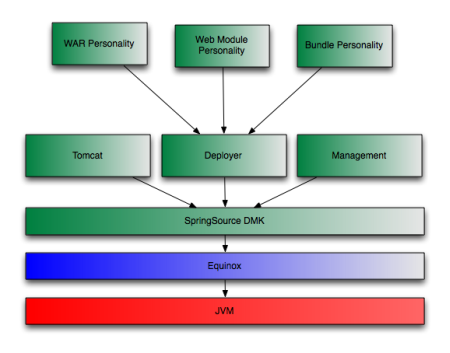
The platform itself can be configured through profiles. For example, if your application doesn't need a web interface, the platform doesn't have to run a service providing the servlet interface. It also has a deployer that loads what it calls personalities. A personality is a type of deployable module, such as a WAR, a web service or a bundle.
In the words of Rod Johnson, the platform isn't trying to implement Java EE 5 at all, although it's quite likely it will eventually implement one or more Java EE 6 profiles and thus become a certified middleware provider. Johnson also suggested he saw no reason for the platform to support EJB. He has an interesting view of the future of module systems such as JSR 277 and OSGi and of their standardization within enterprise Java.
In general, though, OSGi and Java EE are not traditionally compatible. But, as as OSGi becomes more important, this is something that Java EE will need to deal with, and not the other way round. We feel that Sun is becoming much more open than before and are very heartened by JCP developments recently. JSR-277 and OSGi will come to a good accommodation that will provide the best possible outcome. We believe that JSR-277 and OSGi will play nicely together, what with Sun getting more serious about openness.
As mentioned at the start, the platform is now available as a 1.0 beta. It isn't available under an open-source license yet, but work is underway. Plans for version 2.0 include middleware integration (TIBCO, EMS and IBM MQSeries) and important enterprise features such as clustering and an administration interface. Definitely try it out, then, but it looks like it'll take version 2.0 to be ready for a real deployment.
One last question and answer I couldn't resist quoting, for more than just the humor.
Finally, what factors make you believe that the Spring Application Platform will succeed?
…the time is also right because traditional application servers were conceived when Bill Clinton and Monica Lewinsky were in the White House.
Related Dagblog articles
Related articles
Related CZ Podcast episodes
- #261 · Leadership
On leading people and teams. · Czech audio
- #3 · Java 6 SE, Vývoj webových aplikací
Dagi and Filemon discuss Java 6 and web application frameworks. · Czech audio
- #1 · Vývojová prostředí v Javě
The first CZ Podcast episode looks at Java development environments. · Czech audio