The world isn’t so bad, back to Instapaper, DevOps, the Russian soul, and another podcast
I’m listening to the audiobook Factfulness. You wouldn’t believe how badly out-of-date information and the media distort our view of the world. Did you know, for instance, that 80% of the world’s children are vaccinated? The world really isn’t so bad. Read more about this excellent book in the review of Hans Rosling’s Factfulness. Or listen to an audiobook sample.
Do you use a service to save articles for later? It’s useful if you spend time without a signal or simply want to keep articles from getting lost. After it came back to the EU I decided to move back from Pocket to Instapaper. Instapaper just feels less cluttered to me, though I admit that’s subjective.
The Signal vs. Noise blog from 37signals is moving from Medium to WordPress, and DHH explains why.
These days Medium is focused on their membership offering, though. Trying to aggregate writing from many sources and sell a broad subscription on top of that. And it’s a neat model, and it’s wonderful to see Medium try something different. But it’s not for us, and it’s not for Signal v Noise.
Writing for us is not a business, in any direct sense of the word. We write because we have something to say, not to make money off page views, advertisements, or subscriptions. If some readers end up signing up for Basecamp, that’s great. But if they just like to read and not buy, that’s also great.
DevOps is first and foremost a cultural change. Everything else comes second. What DevOps Taught Us in 2018.
… doing DevOps right means approaching DevOps in a systematic, platform-centric fashion and letting the culture fall into place naturally. Fix the root causes, and the symptom will go away. Whatever we call it, the end goal is to make the process of software development and delivery more efficient and merge dev and ops for a smooth business operation. Whatever the definition of DevOps is, but the ideology behind is the same.
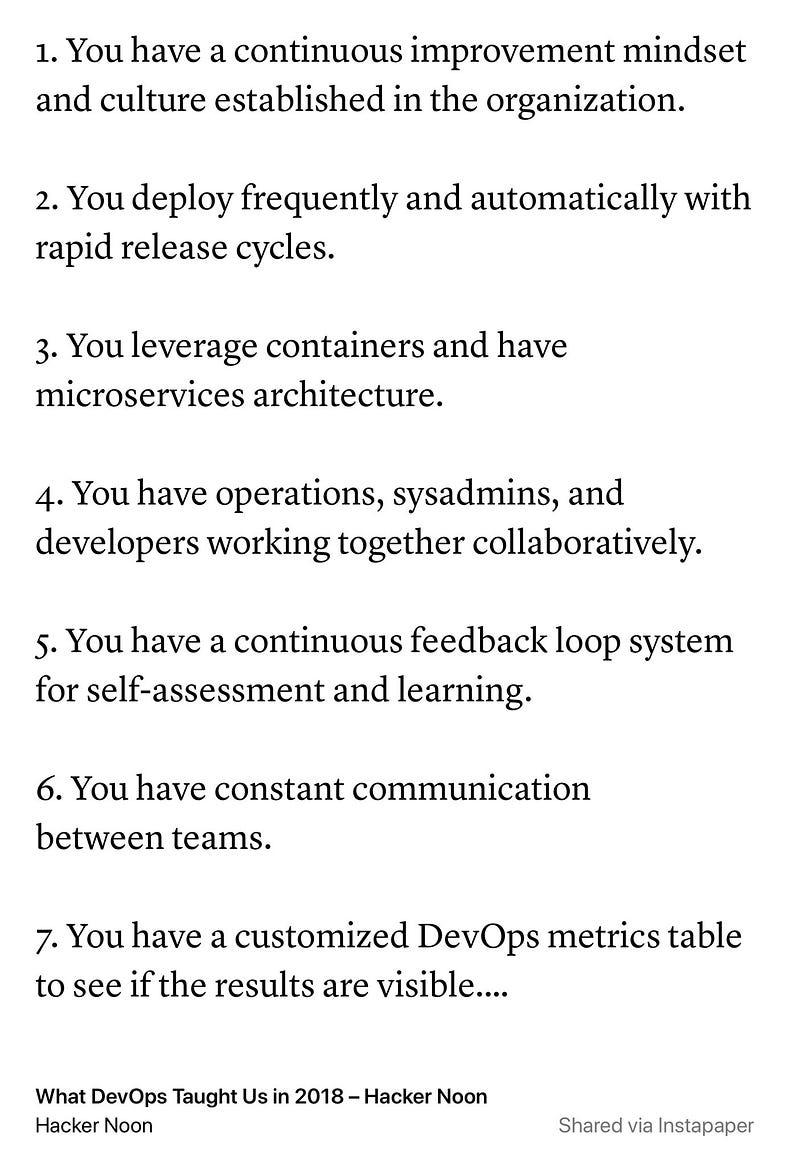
The Death of Microservice Madness in 2018. You don’t have to agree, but definitely read this article. What caught my attention?
There is no microservice architecture. Microservices are just another pattern or implementation of components, nothing more, nothing less. Whether they are present in a system or not does not mean that the architecture of the system is solved.
Microservices relate in many ways more to the technical processes around packaging and operations rather than the intrinsic design of the system. Appropriate boundaries for components continues to be one of the most important challenges in engineering systems.
The purpose of a performance budget is to make sure you focus on performance throughout a project. The reason you go through the trouble in the first place though is because you want to build a site that feels fast for your visitors.
One of these goals (prioritizing performance) is an internal one impacting the people who are creating the site. The other goal (building a site that feels fast) is an external one impacting people who visit your site. It’s not surprising that I’ve found the most effective metrics to differ for each.
A little controversy
Is any armed resistance controversial? Of course, to those who can always adapt and get along with an undemocratic system, the struggle is controversial. The same goes for those it is directed against. The fighters stand apart and their actions make us think, get upset, and perhaps worry a little about how we ourselves would act when confronted with immediate evil.
Fair warning: I like the Mašín brothers. But this piece is about something else. I offer it as food for thought. Controversial. All the things we can hide behind that word
On the peculiarities of the Russian soul
I once told a joke in Russia: “Russian engineers built a tank for 100 people. One sits and 99 push.” It didn’t exactly go down well. Only after reading Russian roulette as evidence of a tragic disregard for life: crashes, disasters, accidents, and explosions in Russia did I perhaps understand why.
“While verbal and logical thinking is characteristic of Westerners, Russians tend toward imagery and intuition,” Sergeyevova argues. She says a Westerner acts according to their will and judgment, while an Easterner acts much more on feeling, intuition, and faith that everything will turn out as fate intended. This way of thinking is somewhat risky when building gas pipelines, high-rises, or submarines.
This week I was looking forward to switching on the microphone after a month and recording another CZ Podcast. We originally meant to do a short update to say we were still alive. In the end Jiri Fabian ☢ brought Aleš Roubíček along, and the topic was Pull requests, merge requests, and other musings on the nature of team development.
I like it when a podcast sparks a discussion and people get talking. It went pretty well this time. Since we spent most of our time on code review, here’s Where the shoe pinches: code review by Luboš Račanský
I have a draft that takes a broader view. Its working title is On processes and people, a little code review, hassling people, and feedback.
Questions and answers
Caught in my social bubble.
Q: A Polish colleague learning Czech asked when people say “ty vole” in Czech. I don’t know what to tell him.
A: “(Ty) vole” is used instead of a form of address, at the start of a sentence, in place of a comma, period, colon, semicolon, exclamation mark, question mark, and the conjunctions and, also, so that, but, and when. Depending on the speaker, the optional ty is used always, as a form of address, at random, or never. Oh, and sometimes as an insult.
Related articles
Related CZ Podcast episodes
- #261 · Leadership
On leading people and teams. · Czech audio