Run Slowly. That Is, Run Smart.
On Friday I gave my colleagues at Zonky a talk (video) about how to enjoy running without feeling as though you’re getting nowhere. I boiled it down to a slightly sensational line: you have to run slowly. I admit there’s another way to say it: run smart. But some people take running smart to mean thinking about what to buy for dinner or whether the kids have done their homework while they run. Running slowly really means running slowly, or relatively slowly. What counts as slow varies from runner to runner. Whether you’re aiming for a big milestone such as a marathon, half marathon or 10K, trying to get faster, running for fun or health, or trying to lose weight, doesn’t really matter. To me, running smart means understanding how the body works and running accordingly.
Your body gets the energy it needs for running by burning a mix of things: glycogen, “fat” and oxygen. The proportions change with how hard you’re working. If you run too hard, you’ll draw on glycogen stores. If you run at an appropriate effort, you’ll draw on fat stores. So what? First, you only have a very limited amount of glycogen. Burning glycogen produces more lactate. To simplify, the more glycogen you burn, the more lactate builds up, and the harder it gets to run. Once it reaches a critical level, you stop running, park your tortured body at the side of the road and wait for everything to go back to normal. That’s why training, whatever your reason for running, is based on working at intensities between the point where the body can comfortably clear lactate and the point where it stops being able to clear it. Those points are called the aerobic threshold (AP) and anaerobic threshold (ANP), and the best conventional indicator available to us is heart rate.
Most runners, especially beginners, make the mistake of training at or above their anaerobic threshold. If they’re trying to lose weight, for instance, this has precisely the opposite effect. They burn carbohydrates instead of fat, could eat half a pastry shop after training and are so sore the next day they can hardly move. Lactate is a nasty thing. For more advanced runners, frequent training at the anaerobic threshold leads to stagnant performance, fatigue and injuries because the body can’t recover fast enough.
The figure below shows my individual lactate curve, measured before the season in February 2017. The horizontal axis shows heart rate and the vertical axis shows lactate. Specialist facilities can measure your lactate curve. I go to Casri at least once a year. The test involves running four-minute intervals on a treadmill at progressively higher speeds. They measure your heart rate and take a drop of blood after each interval to measure the lactate produced at that effort.
There are two important points on the curve. The aerobic threshold is where it starts to bend. Up to that point, the body has been clearing lactate comfortably. The anaerobic threshold is where it bends sharply. Beyond that, lactate builds up too quickly.
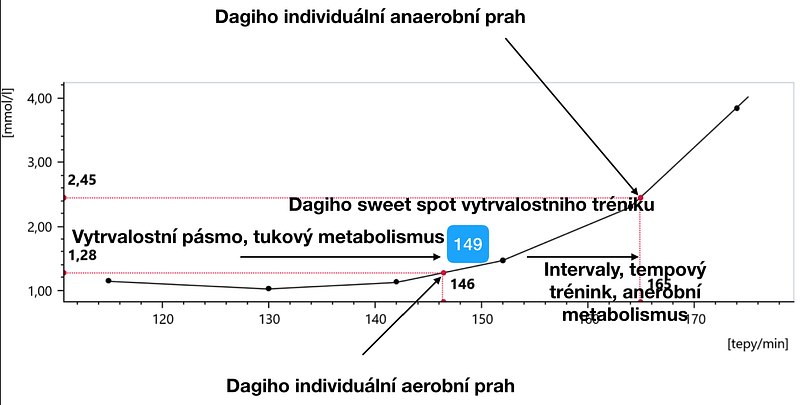
My aerobic threshold is 146 beats per minute. Around that heart rate, my body uses fat metabolism. Ideally I train two or three beats above it. That’s my sweet spot for burning fat efficiently. I spend 80% of my training at 149 beats per minute. My anaerobic threshold is 164, and I spend very little training time there, typically one interval session a week.
Replace heart rate on the horizontal axis with speed and we can see what pace I’ll run at, in minutes and seconds per kilometer.
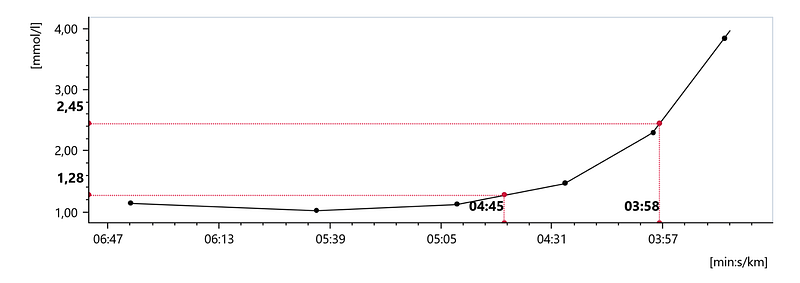
The aim of all this training is to shift the entire curve to the right, meaning you get faster between the two thresholds. If you’re losing weight, of course, you can forget about speed and focus on keeping training at around the aerobic threshold or below. Different races also call for different heart rates and efforts. In a 10K you might hammer along at 10% above your anaerobic threshold because you’ll only be there for tens of minutes. In a marathon you run just above your aerobic threshold so your body can sustain the effort for several hours.
You can calculate the two thresholds, too. It’s less accurate, but a starting point is better than running completely blind. You need your maximum heart rate (220 minus age for men, 230 minus age for women) and resting heart rate, measured in the morning after you wake up. Then plug the numbers into an online calculator, which will spit out the results. You can also estimate it. Generally, we move past the aerobic threshold when we start to get a little out of breath.
I’ve simplified some things here, partly because I’m neither a doctor nor a coach and partly because I didn’t want to overwhelm readers. I recommend the following articles if you want to read further. Happy smart running.