Czechman 2018 postmortem
I've just raced Czechman, a half Ironman with a 1.9 km swim, 90 km bike and 21 km run. Last year I did the same course in 5:46. This year's clear goal was to improve and, ideally, get close to five hours.
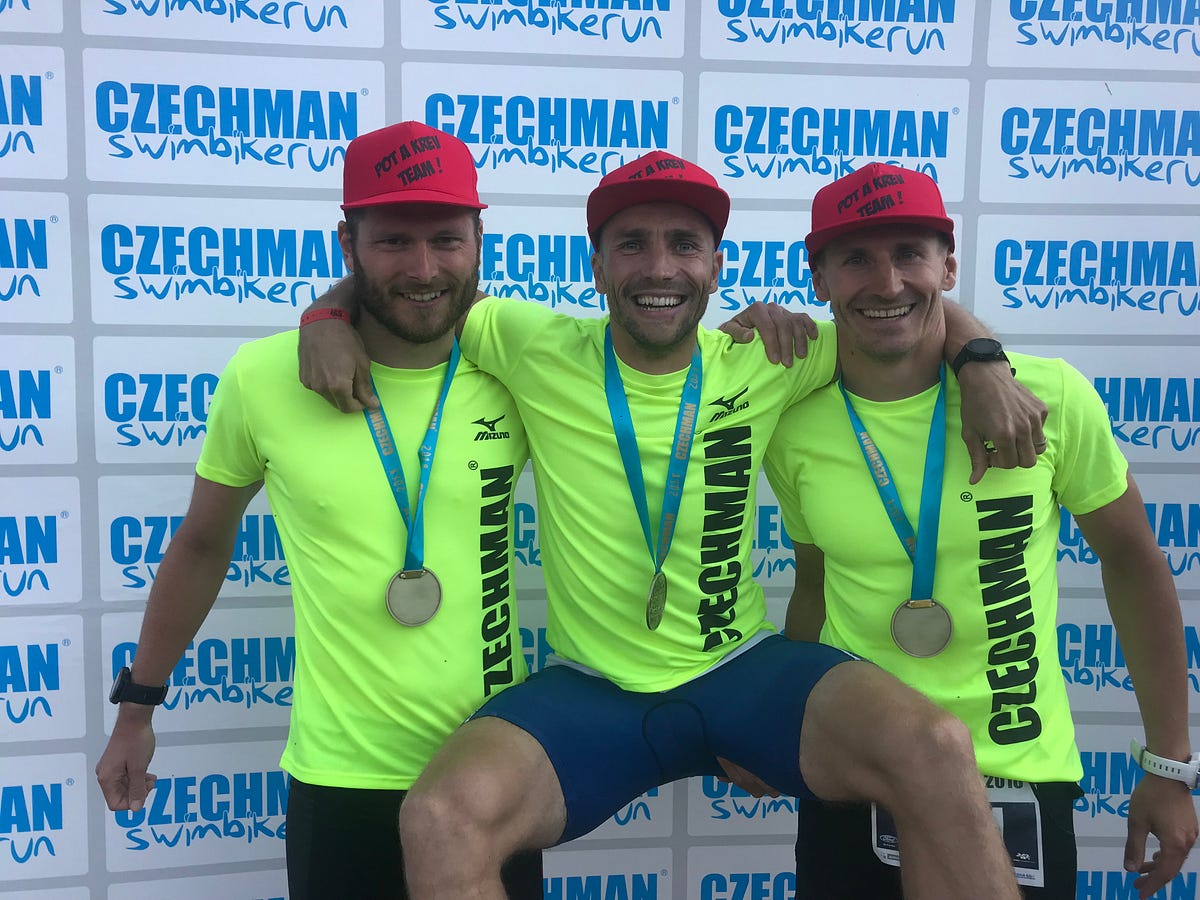
Honza Falge and I changed several things in training. My bike leg was really weak last year, so this year I went to a training camp in Mallorca and also started using a power meter. Power, rather than perceived effort or heart rate, set the intensity of my training. Before that I did an FTP test to determine my maximum sustainable power, which is the basis for training and racing.
According to TrainingPeaks, my fitness on race day was about 30% higher than the same time last year. I ran a personal best of 1:24:56 at the Prague Half Marathon, and my pool times suggested I could swim at 1:50 per 100 m. A week before the race I tested my form at the Zátavský triathlon (750 m, 20 km, 5 km), and everything looked great.
I probably made a few mistakes in the final week of preparation. It started innocently enough when my power meter ran out of battery. I started thinking about what would happen if it broke during the race. The first sign of trouble. Then I wondered how many watts I should ride at so that I could run well. For some strange reason I convinced myself my FTP was 268 W (it's actually 95% of that, or 255 W). I wanted to ride at 80% of FTP, which should be a safe limit.
Of course we'd been egging each other on all week, and I get carried away with that. I decided to take a risk and put everything on one card. I did all my bike training on a road bike but chose a time-trial bike for the race, even though Honza tried to talk me out of it. Never try anything in a race that you haven't tested in training. It was all in my head. I felt I wouldn't manage without it.
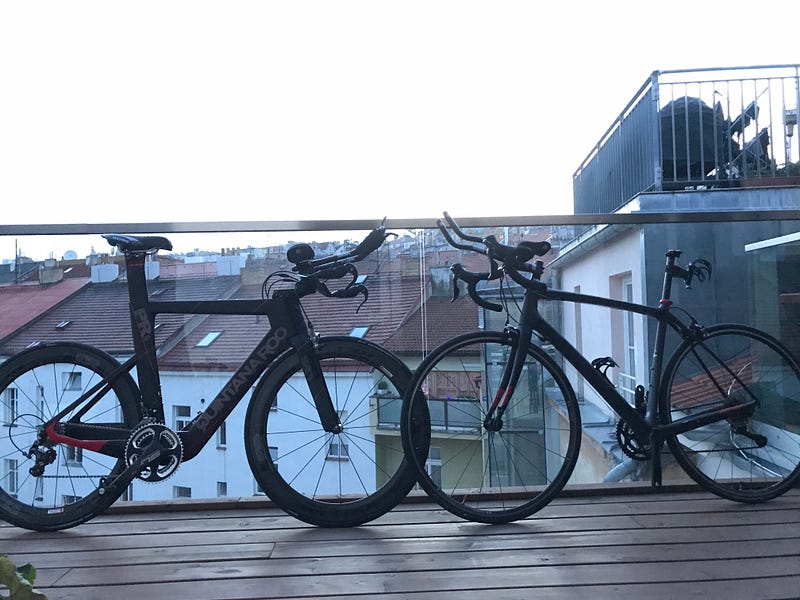
I picked up the bike on Thursday, with the race on Saturday, and started frantically adjusting it: swapping the saddle, setting my position and so on. At first I couldn't hit my race power on the trainer at all. I was getting less power for more effort. I rode it on the road on Friday morning and the numbers still didn't add up, but the bike felt great.
When I charged my watch for the last time at around 11 p.m. on Friday, I found a new firmware update. On it went. What could happen? Suunto must have it sorted. While I was at it, I set the cycling display to show only watts and cadence during the race. Above all, no speed or time to throw me off. While fitting the bottle cage I started wondering if I even needed two. Thanks to Google I learned about aerodynamic drag (roughly 30 seconds over 40 km) and where to put the cage. Of course I dutifully watched the wind tunnel videos and decided I'd ride with just one bottle. Aid stations would be frequent, so why carry extra weight? Windy was predicting cloud and a little rain anyway. I didn't look at the wind forecast.
To sum up, I started the bike leg on a bike I'd ridden for two hours, including an hour on the trainer, with a watch updated to the latest firmware and a display set up around numbers I'd never ridden by. I had one bottle for hydration.
A digression about watches, watts and my obsession with them. On the trainer I watch watts, cadence and time. Outdoors I add speed. I do two-thirds of my bike training on the trainer, pretty much everything up to an hour and a half. The advantage is that you can follow the planned power precisely. I do longer sessions of three hours or more outdoors, but keeping to a power target there is hard because the course profile varies.
I don't get terribly nervous, but about three times I dreamed I'd miss the start. It was a nightmare that kept cropping up. Saturday was hectic: getting to the race, my child, my wife, the borrowed bike, registration, transition and so on. I didn't have time to warm up properly, on land or in the water.
Swimming is my weakest discipline. The goal was somewhere between 35 minutes (happy) and 38 minutes (okay). I got out of the water after 40 minutes. Once again I hadn't swum the best line. A crappy first leg always throws you off a little. Next came the bike. It went well as soon as I got out on the road. I must have passed fifty people and was congratulating myself on a great decision. Except the power numbers still didn't add up. I was riding below target. I didn't worry about it because everyone else looked almost stationary next to me. At about kilometer ten my watch restarted! I lost all my data, most importantly the time elapsed since the start. Of course I could have checked the time of day since we started at noon, but that didn't occur to me.
After the first aid station, 30 km in, I drained my one bottle and had another 30 km ahead without a drink. The sun was beating down like the Sahara and I started wishing I'd never looked into aerodynamic drag. For a moment I considered asking another rider for a bottle. A rookie mistake. Fortunately, at the next station I took two bottles and immediately drained one. Crisis averted. Windy is a great site for wind forecasts and I often use it for kiting, but this time I hadn't paid attention to the wind. It blew hard. With deep rims, the wind shoved you around sometimes. It was mostly a crosswind or headwind. I didn't think much of it because I kept passing people. I only saw my speed once, on a radar sign in a village that showed 35 km/h. I felt I was on for 2:35. At the finish the watch showed 2:37 for the bike. And I'd ridden at lower power, so I had more left for the run. Now that's more like it!
A quick transition and I head out on the course. I check the time for the first time. 15:51. Hang on, something's off. If I swam in 40 minutes and biked in 2:37, how have I been racing for nearly four hours? I can't make sense of it for the first kilometer. Then it hits me. Damn, the watch restarted. The bike time wasn't 2:37. It was 2:54. A cold shower. The five-hour dream was gone, so I'd run for pride. The plan was to start the run slowly and speed up to 4:22. I'm running at a 5:00 pace with a slight stitch and trouble catching my breath. I stay calm, expecting to open up after the first few kilometers.
And I never did. My head wasn't in it and neither were my legs. I struggled through the run, really struggled, in 1:46. It was supposed to be my best event, and instead I ran miserably. On the finishing straight a guy nails the lid on my coffin by beating me by the width of a Korean woman's breasts. I'm completely spent. My finish time of 5:28 is 18 minutes better than last year but still 28 minutes off my personal goal.
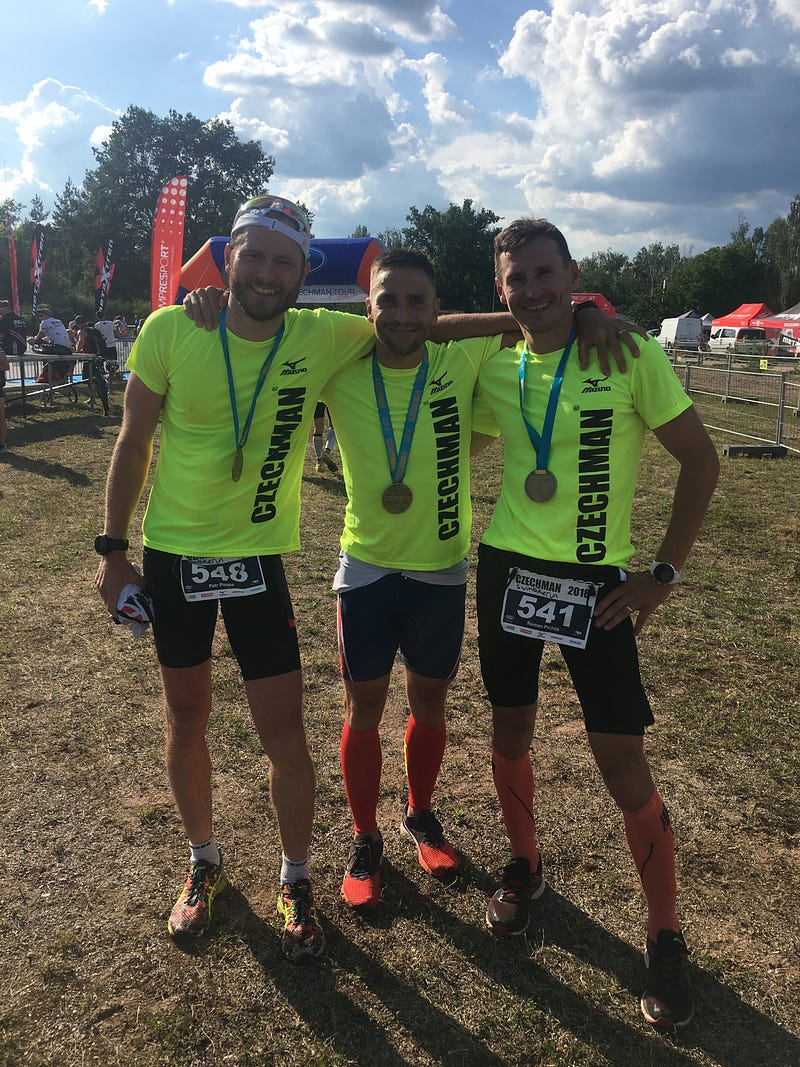
By the way, you can tell how hard this year's race was from the fact that 10% of starters didn't finish . The tropical weather, technical problems or going too hard on the bike took them out. As Jarda Jágr would say, that's sport.
Mistakes
A mistake you don't learn from remains a mistake. The rest is experience.
- A time-trial bike I hadn't tested.
- Updating my watch firmware just before the race.
- Setting up the display badly. I'm on the fence about this one. It may actually have saved me from blowing up on the run.
- I rode at lower power than planned and still couldn't run well. The data looked less bad by heart rate than by watts.
- A poor line on the swim. I need to swim more in open water.
- Fussing with things like aerodynamic drag and using just one bottle cage, which almost did me in through dehydration. That could have caused the stitch on the run, by the way.
- Underestimating pre-race chaos and the stress that came with it, including the warm-up I didn't do.
- Don't watch the other riders or get carried away by how the bike feels. Watch another absolute indicator, such as speed or time.