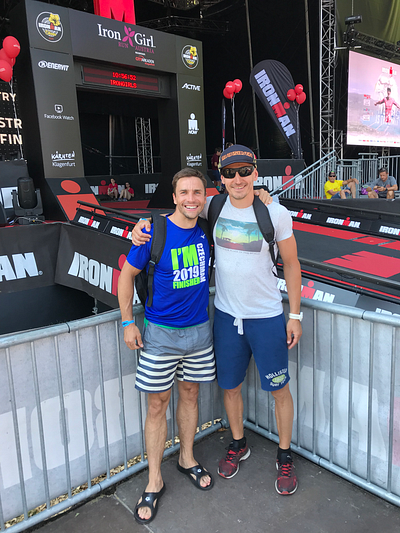
Ironman Klagenfurt 2019
Becoming an Ironman for the First Time, the Hard and Slow Way
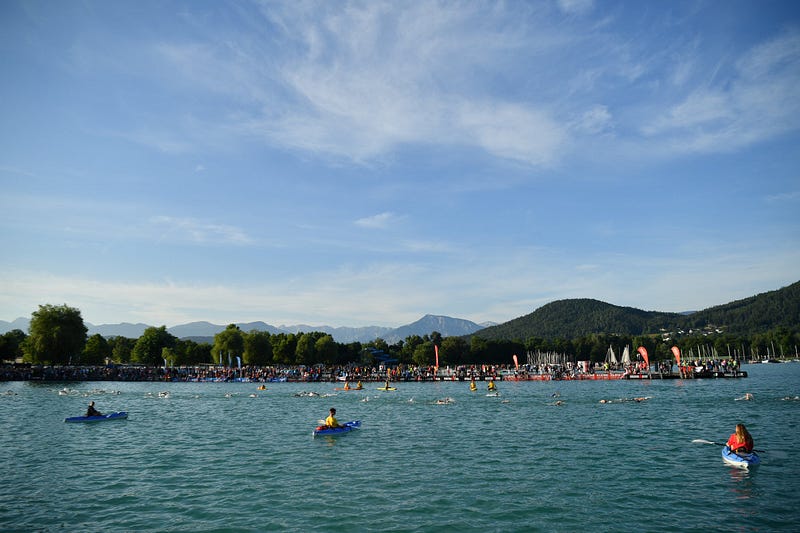
5, 4, 3, 2, 1, go! My first Ironman begins with a rolling start. I run into the emerald waters of the Wörthersee in Klagenfurt, and the calculator in my head starts up. To swim 3,800 meters, I’ll have to take about 3,500 freestyle strokes. If I breathe every third stroke, that’s roughly 1,200 breaths, divided by two: 600 to the left and 600 to the right. Now I have something to work with. There’s nothing worse than thinking about something you can’t even imagine. I guarantee that thoughts like that will come over you during the race and in training for it.
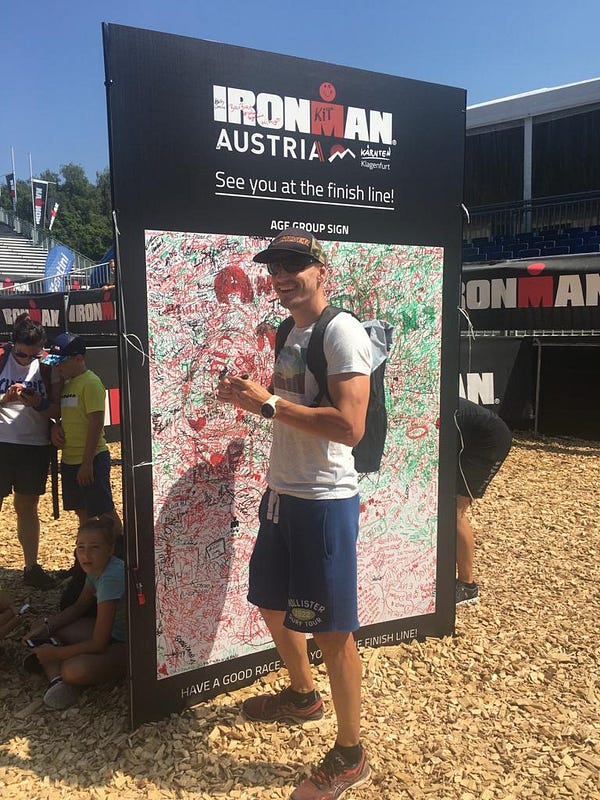
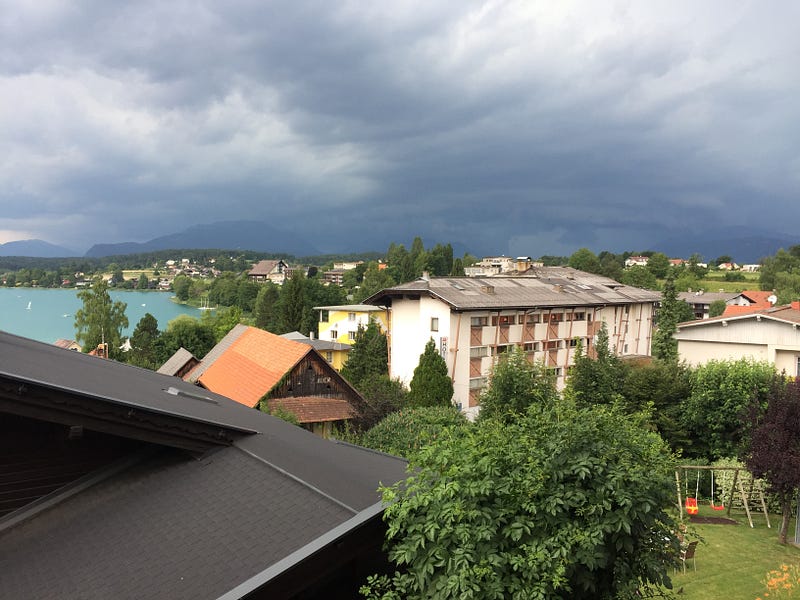
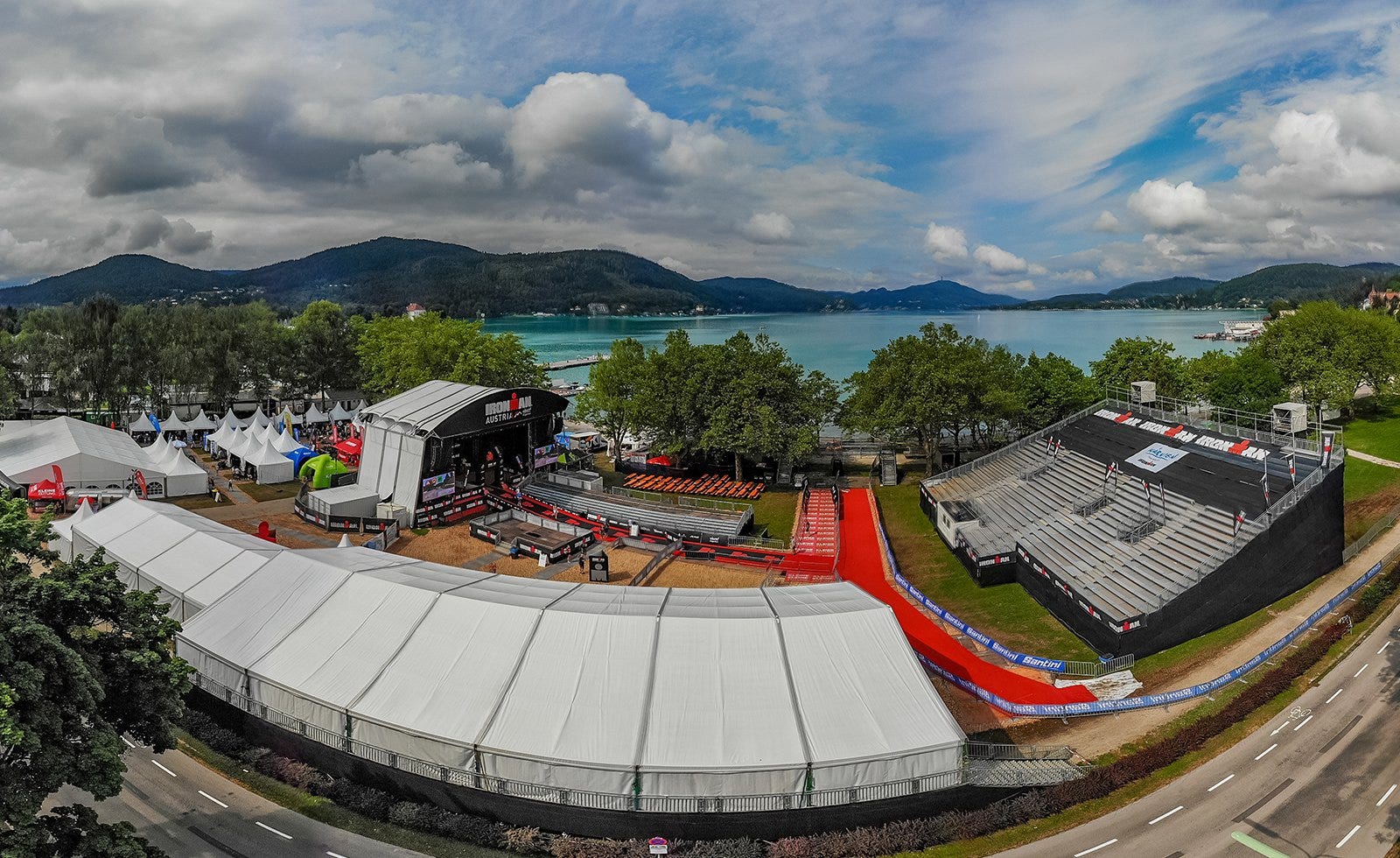
I first started thinking about Klagenfurtas the venue for my first Ironman while on holiday by Faaker See in summer 2018. On every walk or ride in the area, there was something to remind us of the race. The local hills were covered in spray-painted messages to the competitors, and there were signs marking the route, rough patches and hazardous sections. In Klagenfurt we saw the race expo and the whole circus around it. More than two and a half thousand competitors start the race. A favorable bike route with about 1,400 meters of climbing, a swim in a crystal-clear lake, a hundred thousand spectators along the course and a location with plenty to do for families make Ironman Klagenfurt one of the most popular races in the Ironman series. The entry slots go in the first few hours after registration opens, even though the fee is anything but cheap.
Training, training, training makes champions
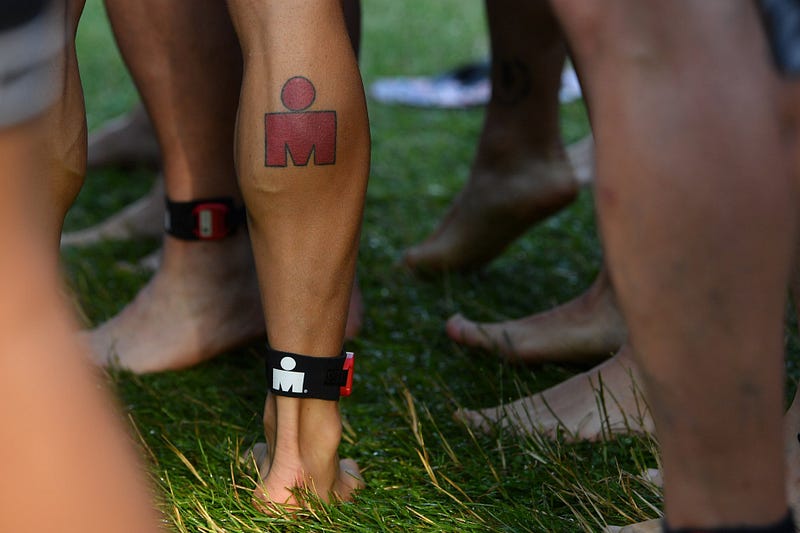
Did I say training? I started preparing systematically in October 2018. I wrote about some of the more interesting episodes in my article on this year’s Czechman. Preparation wasn’t all that different from earlier years, when I trained for the half distance. As Poupičsays, it’s just a longer ride and a longer run. Here are the training hours by month: October 46, November 35, December 35, January 47, February 38, March 55, April 55, May 65, June 57. Over 44 weeks, that averaged ten hours a week. From March through June, when the weather and daylight let you go for longer rides, I trained 14.5 hours a week.
All told I spent 182 hours on the bike, 41.5% of my training time, with 2,825 kilometers outdoors. I don’t have an exact total because the trainer doesn’t measure distance. At 25 km per hour it would come to 4,500 km. I spent 113 hours in running shoes, 25.8% of the total, and ran 1,266 km. I spent 119 hours in the pool, 27.1% of the total, and swam 268 km. The remaining 7% went to the gym, physiotherapy, cross-country skiing and corrective exercises. I’m not counting coffee and breakfast with Pot a krev at our home base, the Mezi řádky café. Hello to Jarda, our resident bartender!
Quite often, when I say Ironman and give someone the distances, the response is: I understand all that, I know how it works, I could ride it, I could handle it, but I can’t imagine the swim. I’d definitely drown. I always say, oh no, you swim in a wetsuit. It keeps you afloat. Nobody can drown in one. Relax. There is, however, a rule that the organizer can call for a swim without wetsuits if the water is warmer than 24 degrees Celsius, because of the risk of overheating. Nobody cares that this isn’t terribly likely when you start at half past six in the morning. Safety first.
I do wonder whether it was actually safer to let everyone swim without wetsuits. Knowing how far I had to go, I tried to work long, continuous stretches into training. A normal swim session lasted 60 minutes, in which I swam 2.5–2.9 km. A session with longer stretches of 800 meters or more lasted 75–80 minutes, in which I swam 3.5 km. The long stretches helped a lot, and I was calm even though we would be swimming without wetsuits. Swimming without one slowed me by five to ten seconds per 100 meters, but I didn’t worry about it. What mattered was swimming the distance.
I have a recurring triathlon nightmare. In it, I’m wheeling my bike into transition while the race is already underway. In Klagenfurt, that nightmare almost came true. Looking back, it was a scene straight out of Dumb and Dumber. We dropped our kit in transition, the area where you change equipment between disciplines, the day before. It was baking hot, so like most of the other competitors we let air out of our tires to keep them from bursting in the sun. We planned to pump them up and divide up the food and drink on race morning. Transition was open for that from 5:30 to 6:15. The race started at 6:30.
We were staying outside Klagenfurt, so we left just after five in the morning to get to transition when it opened. We’re driving down the motorway, wondering which exit it’ll be. Of course we take the wrong one. Instead of Klagenfurt we’re headed for Slovenia, Italy or wherever the road goes. I stayed icy calm because we still had time, and we turned around at the next exit. We were finally coming up on the right one, and it was 5:45, when we saw it was completely jammed. To this day I don’t know whether it was spectators or competitors who’d had the same idea as us and come at the last minute. We got to the exit and were the very first car they wouldn’t let into the queue. Najmič gestured furiously: the race, the time, we’ll miss it. He couldn’t persuade the man in charge of closing it.
He sent us on our way with the helpful advice to try the next exit. I was starting to feel faint. Fortunately, the next exit took us to a park-and-ride lot. What a surprise, there wasn’t a spot left. To be precise, there was no spot for a decent Austrian, German or Swiss driver to park. For anyone used to parking in Vršovice back home, it wasn’t a problem. I dumped the car right in front of some perpendicular motorcycle spaces and quietly hoped the police would be lenient during the race. It helped a little that the Italian driver in front of me had exactly the same idea. We made it to transition by the skin of our teeth.
Hydration, food and diet
Training wasn’t all I did to prepare. I went from a diet overflowing with fast sugars and high-glycemic foods to one based mainly on protein. I ate the sort of food you’d expect a bodybuilder to eat, rather than an endurance athlete. For several months I stopped eating things I’d loved and eaten often: rice, pasta, bread and potatoes. I went high fat, low carb. I wasn’t completely nuts, so it wasn’t keto. The aim was to teach my body to run on fat metabolism, with a virtually unlimited supply of fuel.
What did I eat? Eggs, cheeses, yogurt, meat, soups, nuts and vegetables. An avocado-and-egg spread became a favorite. Part of teaching my body to run on fat was a special training session, a 30–40-minute morning run on an empty stomach. You just get up, put on your running shoes and go at an easy pace. I later renamed that workout the morning shit.
I kept half an eye on my weight. At 183 cm I wanted to get down to 74 kg, but I never got close. My weight settled at 76.5 kg. Looking back, it wasn’t just what I ate but how much. I was still shoveling in an enormous amount. In terms of calories and weight, low carb or high carb makes no difference if you simply eat too much. The weight won’t come off. I couldn’t cut out food in the evening, either, because you have to eat something after an evening workout.
My weight mattered because of the bike. The magic formula is watts per kilogram. Higher is better. You can increase power, lose weight or, ideally, do both. Professional cyclists do 6 W/kg. Recreational cyclists do 4–5 W/kg. With an FTP test result of 280 watts, 95% of average power over 20 minutes, and a weight of 76.5 kg, that’s 280 divided by 76.5, or 3.66 W/kg. If I lost weight to 74 kg and kept the same power, I’d get to 3.78 W/kg. To do it by increasing power while staying at 76.5 kg, I’d have to go from 280 to 290 watts. A mere ten watts, or about a month of hard work by my estimate. If you don’t want to be the outsider everyone flies past on the bike, my 3.66 W/kg is the minimum.
Let’s set the numbers aside for a moment and get back to food before and during the race. Before the race I adjusted what I ate and drank to get my body as ready as I could for 10–12 hours of exertion. The race was on Sunday, and on Tuesday I started carbohydrate supercompensation. I cut carbs to an absolute minimum to use up my stores completely, helped along by shorter, more intense workouts. From Friday I did the exact opposite: lots of carbs, including oats, bananas, pasta and rice. The idea is that the body responds by storing more energy. I also cut caffeine out altogether. No coffee, tea or Coca-Cola. I wanted to get it all out of my system so that it would give me a proper kick during the race. I normally drink two or three coffees and this was torture. I also took extra magnesium, salt and minerals every day to ward off cramps.
The race started at 6:30. You don’t get much to eat during a race, so breakfast is the most important meal of the day. The alarm got me out of bed at 4:00 so I wouldn’t start on a full stomach. The evening before I’d made oats with banana and peanut butter and boiled some eggs. It was a mountain of food, but nerves meant all I could get down was the oats, one egg and a little orange juice. I prepared the following for the race. For the bike, three flapjacks, two Snickers, two Corny bars and a whole banana. I could choose whatever I felt like. I also took Anti Cramps salt tablets and mixed six energy gels, all caffeine-free, into a bidon. For the run I had Coca-Cola, which calms an upset stomach and, more importantly, gives you a caffeine kick. I sometimes use Red Bull too, without vodka until after the race, but I decided to skip it because of my stomach. The aid stations would have it if I needed it.
I went over when and what I’d eat and drink, as more experienced racers had advised. One salt tablet an hour. Eat on the bike at least every hour even if I’m not hungry. Drink every 15–20 minutes, and at least one bidon between aid stations. Get it wrong and I risk bonking or stomach trouble. Either one would mean, at best, losingtens of minutes, and at worst failing to finish. I might have prepared more thoroughly than I did for my school-leaving exams. My nutrition plan’s trump card was supposed to be food at kilometer 130, where my family would be waiting. I asked for a ham-and-cheese sandwich. The rules forbid taking help during the race, so they couldn’t hand me the food, but they could leave it beside them.
Swimming
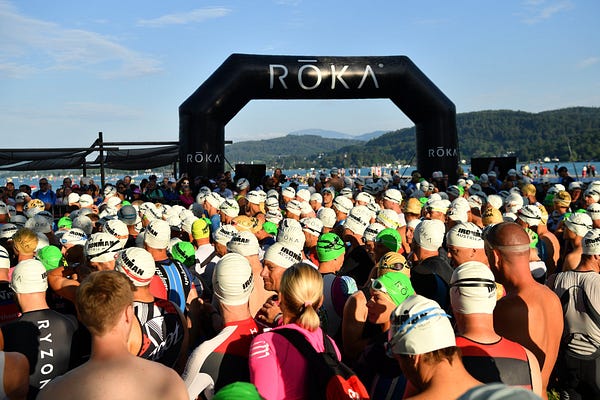
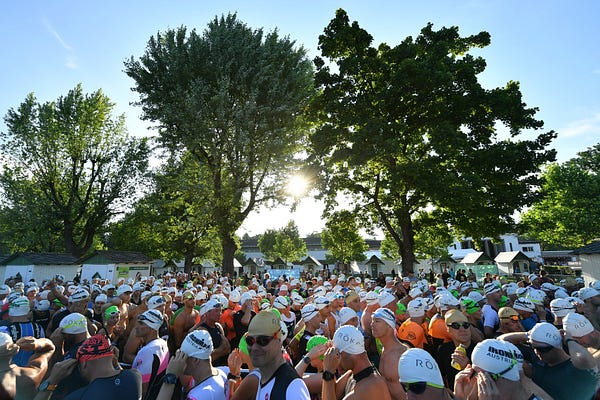
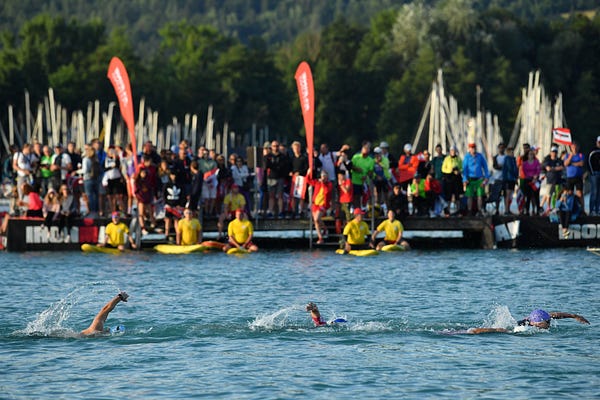
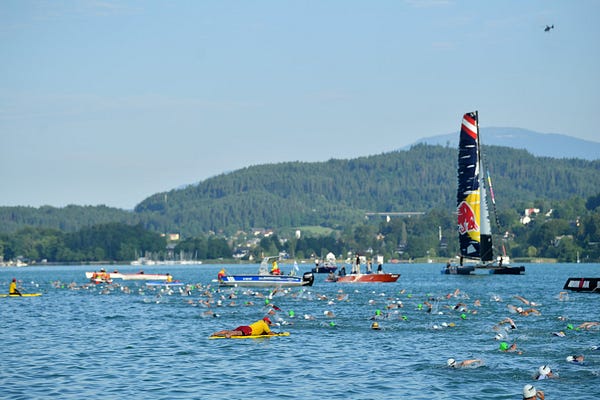
After the hectic time in transition, my faithful companion Najmič and I headed to the swim start. The competitors go off in waves of five, and it takes almost an hour for the very last people to get under way. They line up from fastest swimmers to slowest, but it’s up to you where you stand. We were late, came in from another direction, and got carried away by the atmosphere. We climbed over the barriers and found ourselves among swimmers at a rather different level from us, as we learned within a few minutes.
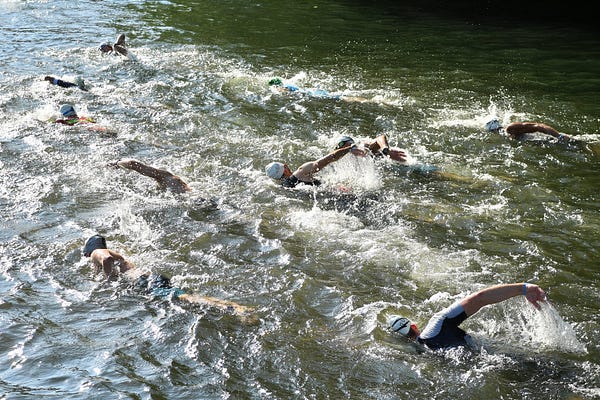
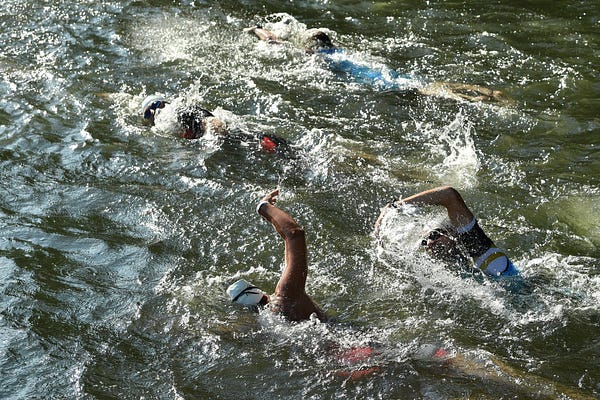
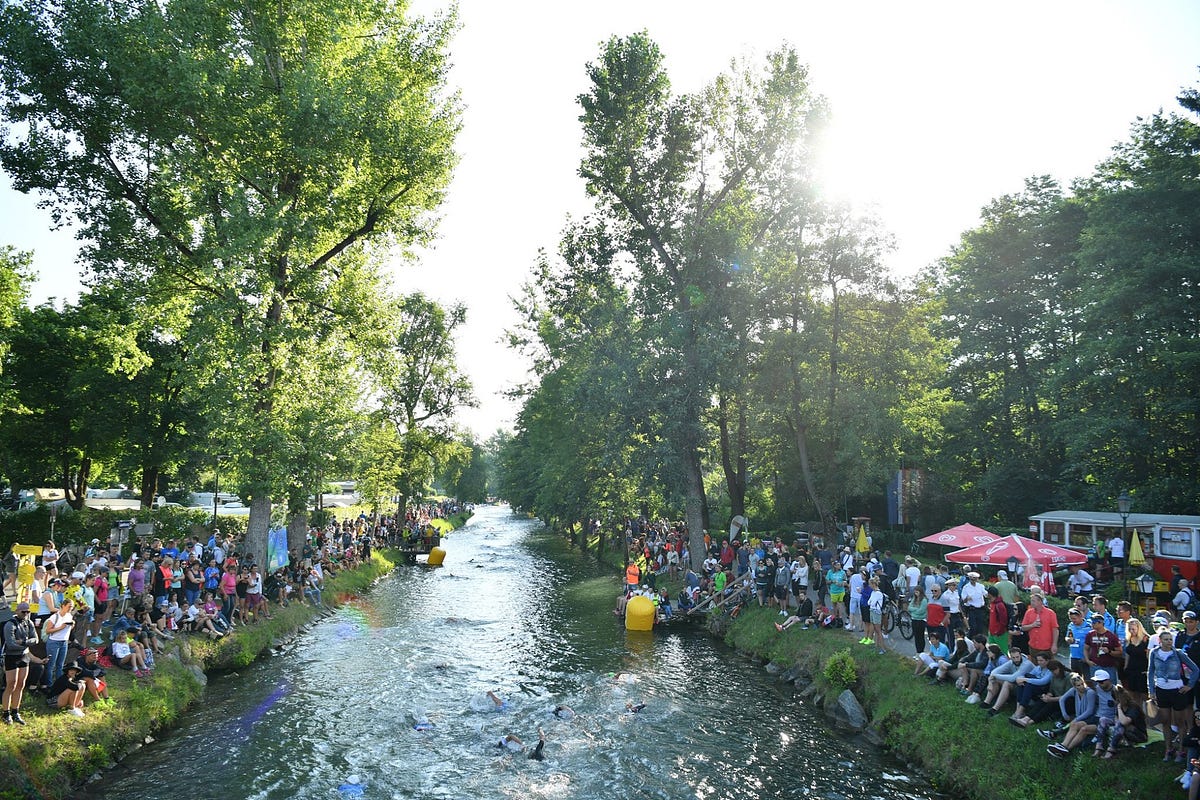
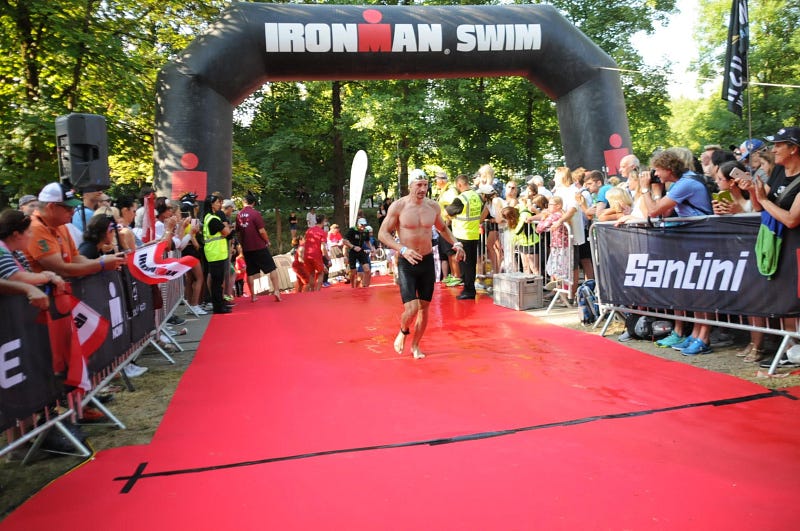
I run into the water and start counting my first strokes. There’s a little under three kilometers in the lake, with the rest in the river that flows out of it. Every thirty seconds or so I have the inescapable feeling I don’t belong there, as the next wave of competitors comes over me like a pack of piranhas. The real massacre came in that river. Well, it was a stream, and I found out what a bottleneck was. Very entertaining for spectators. After an endless kilometer of looking for the end around every bend, I finally get out, genuinely delighted to be done with my least favorite discipline. An hour and twenty-two minutes isn’t disappointing. I’d had no great expectations without a wetsuit.
Transition 1
I run along the carpet into transition and grab my bike kit bag on the way to the enormous changing tent. I sit on a bench and a volunteer is right there, ready to help me get changed. I hesitate when he tries to pull compression sleeves over my wet legs with rubber gloves on. Different places, different customs, I suppose. While he packs the few things I used for the swim, goggles and cap if I remember rightly, I try to pull on my cycling jersey.
The cycling jersey is a practical choice because it has three pockets on the back. That gives me plenty of room for all the goodies I’ve prepared. I have a lovely Pot a krev trisuit with my name and a flag on the back, but Najmič forgot to have pockets put on it. That makes it good for a half Ironman at most, where I can stick the one bar to the bike frame.
I fasten my helmet and run to get my bike. In transition with two and a half thousand other bikes, it’s good to remember where yours is. Luckily it’s divided into sections, and I remember F8. I get on the bike and try to wolf down a banana. Bike
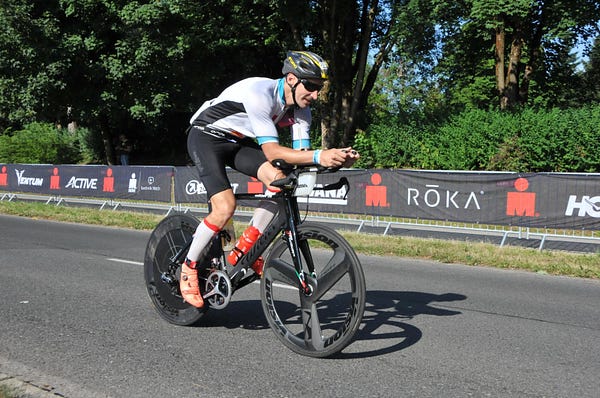
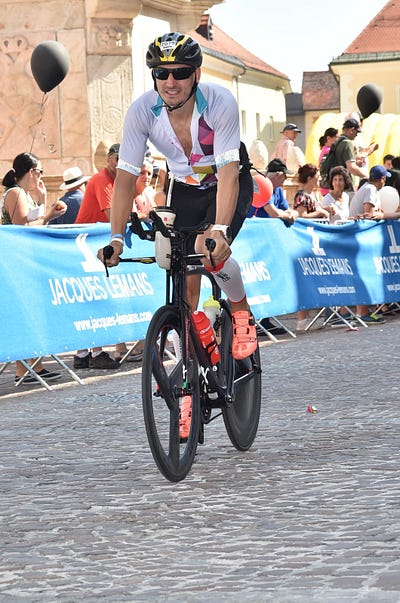
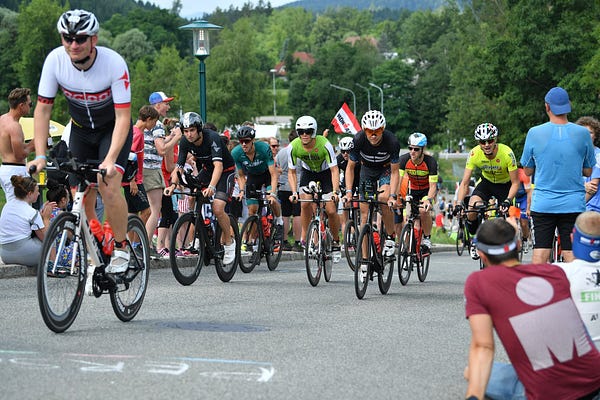
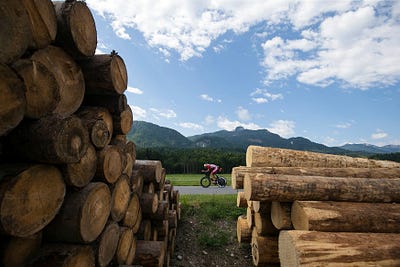
Just as I’m stuffing the last third of the banana into my mouth, Najmič rides past. The banana falls out of my mouth. Mate, what are you doing here? The champion forgot to charge his watch before the race, so he has no idea what his swim time was. He tells me with complete confidence that he swam an hour and a quarter. It doesn’t add up with my time because he’s usually quicker in transition than I am. After the race it turned out he’d probably sighted badly in the swim and zigzagged like a hare being hunted instead of taking a straight course. I stay with him for the first few kilometers on the bike and then give up because I don’t want to wreck my legs.
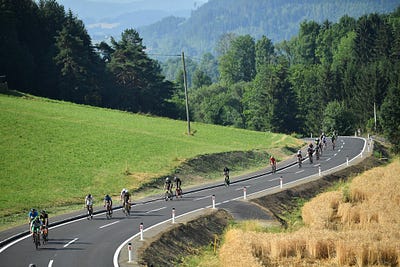
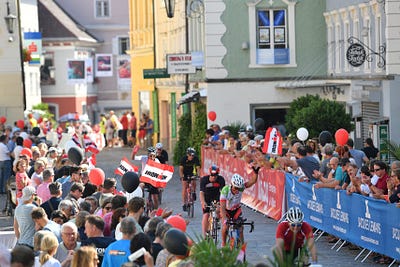
I thoroughly enjoy the first 30 km. The course is practically flat, I take regular sips of my drink, and after an hour I eat for the first time. It turns out that putting my salt tablets in a plastic bag was a pretty stupid idea. The moisture can’t get to the tablets, but neither can my fingers. Getting the bag out of my back pocket, opening it and taking out a tablet, all with one hand at 30 kilometers an hour, is an acrobatic act. I even made it more entertaining once in a village where the road turned to cobblestones. The flat part of the course slowly became rolling, and then came the first little climb. Going up it, I got a taste of how Tour de France riders feel. Fans lined the route, waving flags and encouraging us poor racers crawling upward at a snail’s pace. At one point a grandmother in a camping chair started cheering me on: “noch dreissig meter.”
Relieving yourself outside the portable toilets can get you disqualified, but I saw a few men and women who didn’t let that trouble them and stopped by the road. I usually don’t stop on the bike, and neither does Najmič. A pit stop once cost him a sub-five-hour finish in a half Ironman. You wait for a moment when nobody is behind you, stop pedaling and let nature take its course. If you’re embarrassed, you can throw your head back with a grimace and pretend you’re pouring your bottle over yourself. The stuff running down your leg isn’t water, though, and you won’t fool anyone riding ten meters behind you…
All sorts of thoughts go through your head over 180 kilometers. I’m used to chatting during races. Unfortunately, that’s forbidden here because the drafting rules won’t allow it. But try staring at asphalt for six hours. Every competitor has the flag of the country they represent by their race number. You can tell at a glance whether the person who just passed you is Italian or Estonian. Rules or no rules, I started talking to almost a compatriot, a Slovak named Dany. He looked a little wrecked, and since we were getting close to kilometer 130, where my family were to leave me some food, I thought I’d share with him.
He couldn’t believe I was offering him food. I didn’t mind because I expected a lumberjack’s portion. We huffed up the hill to Egg am Faaker See. There was about 100 meters of flat road after that, and the food was meant to be somewhere there. They couldn’t hand it to me because competitors can’t accept outside assistance. They were so afraid I’d be disqualified that they put it down by a roadside marker under a tree and shouted for me to find it. There were quite a few markers and trees, and I felt like a geocacher. I’d been right about the portion. There was an egg and two proper slices of bread waiting for me in the bag. I happily shared with my new friend, and we both set off in the same direction. His heartfelt thanks rang in my ears: “Fuck all those bars and gels. This is what I needed.”
I didn’t enjoy the bread much because my stomach objected. I stuffed what I hadn’t eaten into the back pocket of my jersey to enjoy later. I didn’t.
The worst patch started at kilometer 140. Before the race I’d filed away in my head that there was only one proper hill left, then a descent into Klagenfurt from kilometer 160. The clock was ticking in the back of my mind because a storm was forecast for around 14:30. The wind picked up a little, I climbed three fairly big hills, and there was still no sign of the damned descent. Then it hit: a hill so steep that some competitors zigzagged from one side of the road to the other just to get up it. I finally clawed my way to the top and began looking forward to a rest on the descent.
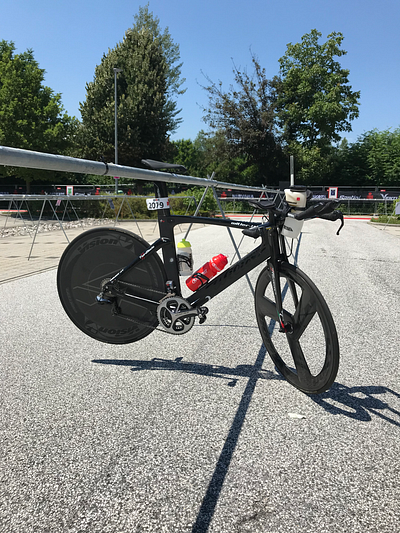
Then it hit again. The sky went black and the wind gradually picked up. Drizzle became rain, and the light breeze turned into a blast. To say the conditions were unfavorable would be a euphemism. I rode straight into the storm. Things looked bad because of the weather, the descent ahead and, last but not least, the disc wheel on my bike. If a gust suddenly hits your bike, there are basically three possibilities depending on your speed and how you’re sitting. One, you somehow stay up. Two, you don’t, but you don’t need an ambulance. Three, you go in an ambulance.
I’d tried option one in training. An unexpected gust came, I just about managed to stay on, stopped by the road to get my nerves back under control, and rode the rest of the way extremely carefully, like a little old lady. Back in the race, I felt as though I’d just ridden into Mordor to be greeted by Sauron himself. Water all over the road, strong gusts. I creep downhill at walking speed, hands on the brakes, having a private conversation with God. If I survive this I’ll never do anything naughty again, and I’ll go with Poupič to play the organ at church.
As if that weren’t enough, the road wasn’t fully closed, and the quarter of it where I was separated from traffic by a row of wind-scattered cones wasn’t very wide. Cars came toward me, their drivers looking horrified if their wipers were keeping up and they could see me. I’ll remind you I was still going downhill. One mistake or a gust could end badly. All that braking, wind and rain made me very cold. I’m not Catholic, but I threw in a few prayers on the assumption that’s how it works for Christians. Finally Klagenfurt came into view and, more importantly, level ground. The rain stopped. You could see right away how much damage the wind had done in town. Barriers separating competitors from spectators had blown over, and bikes had fallen in transition.
I was half an hour too late to avoid nature’s fury. While I was saying prayers and shivering, it caught Najmič in transition and on the run. A six-hour bike split doesn’t look especially impressive, but with the storm and 1,700 meters of climbing it wasn’t bad.
Transition 2
In transition I pulled off my wet jersey, took the rest of the soggy bread out of its pocket, and got ready to run. My teeth were chattering and my feet were frozen, but I figured the 42 km run would warm me up. Coca-Cola, and with it my first dose of caffeine in a week, put me back on my feet. I left what I had to leave in the portable toilet and got to work.
Running
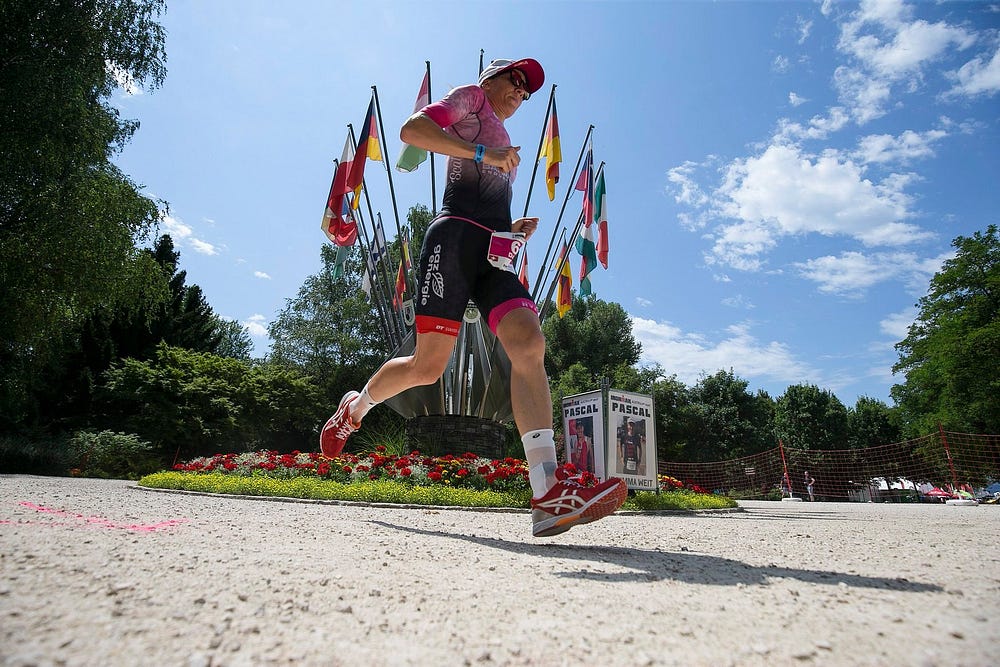
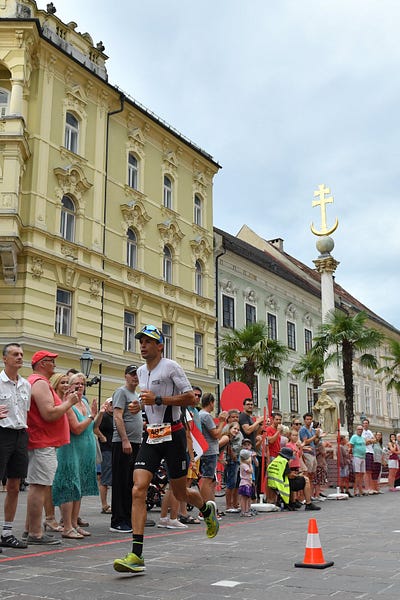
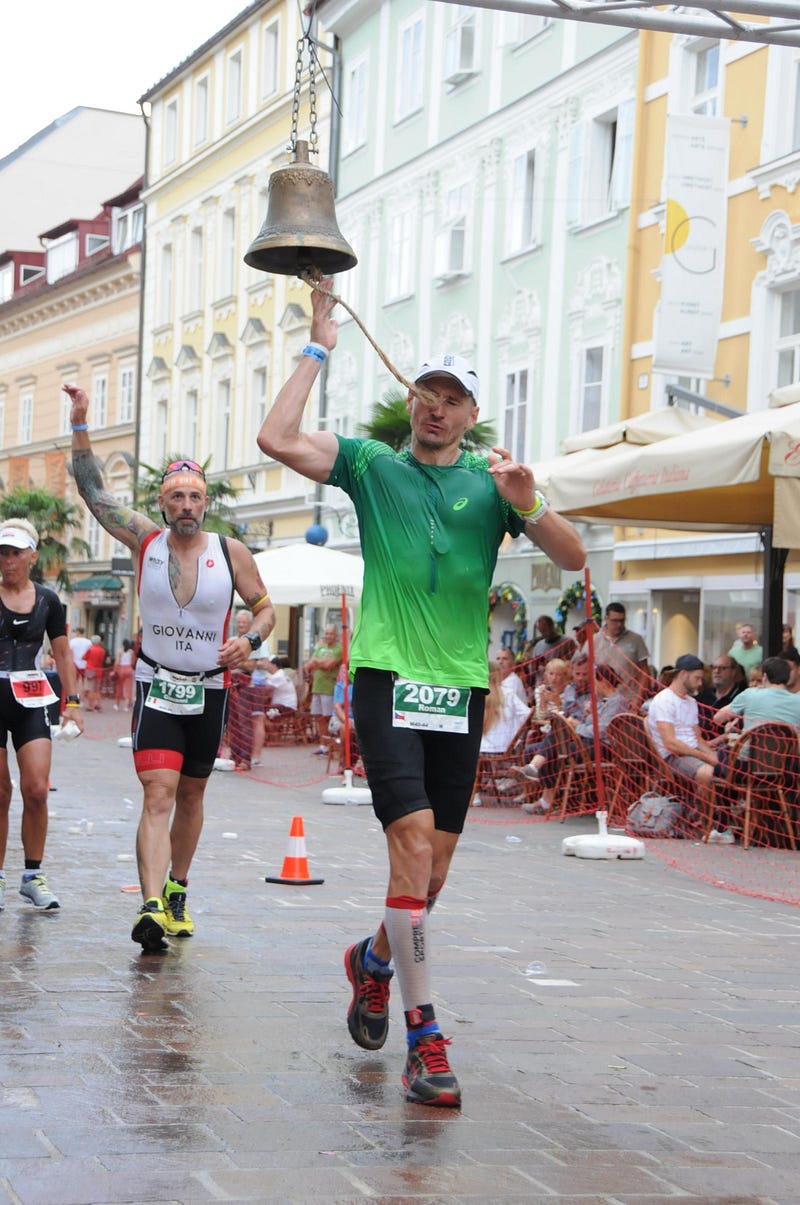
After the storm the weather was perfect for running. For the first few kilometers my feet, frozen like deep-frozen cod, weren’t particularly cooperative, but from kilometer four it went all right. I quickly found a runner going about the same speed. He was Austrian and we had a pleasant chat. Unfortunately I had neither pace nor heart-rate data because my watch had gone into power-saving mode. At kilometer ten I saw Najmič, who looked quite fresh. I stayed with my new Austrian friend until about kilometer twelve, when I hit my first rough patch.
My stomach was churning and I was trying to work out what to do. I’d been sipping Coca-Cola at every aid station, but it wasn’t doing the trick. I needed something solid in my stomach. I knew I couldn’t get a gel or energy bar down. I tried pizza, but it immediately turned my stomach. A good old banana saved me. I still needed the toilet, though. At the first portable toilet I chose, one of the previous competitors clearly hadn’t made it onto the seat in time. It took me a while to work up the nerve for another stop. I wondered what surprise would be waiting for me. Luckily it went well and quickly.
Spectators lined quite a few parts of the route, cheering, and music poured out of the speakers. From kilometer 21 I began to move along nicely. I played a simple game in my head. X kilometers left. That’s like running from home to Y in training with Zdeněk. Twelve kilometers, for example, is like running to the Barrandov Bridge and back. You can’t give up now. Push, it’s just a short way. It worked pretty well.
I saw Najmič at kilometer 36 and he didn’t look good. The thought that we might finish together gave me a real kick. It meant making up at least three kilometers, or fifteen minutes. A complete long shot. I set myself a race within the race: I had to catch him. When I realized at kilometer 39 it wasn’t going to happen, I focused only on running the marathon in three and a half hours. For the last kilometer I had tunnel vision and was trying to hypnotize the clock.
Finish
I didn’t enjoy the red-carpet finishing straight with the spectators in the stands, where most competitors raise their arms and wait for their names over the speakers. I ran through so quickly I didn’t hear the announcer welcome me with “Roman, you are an Ironman.”
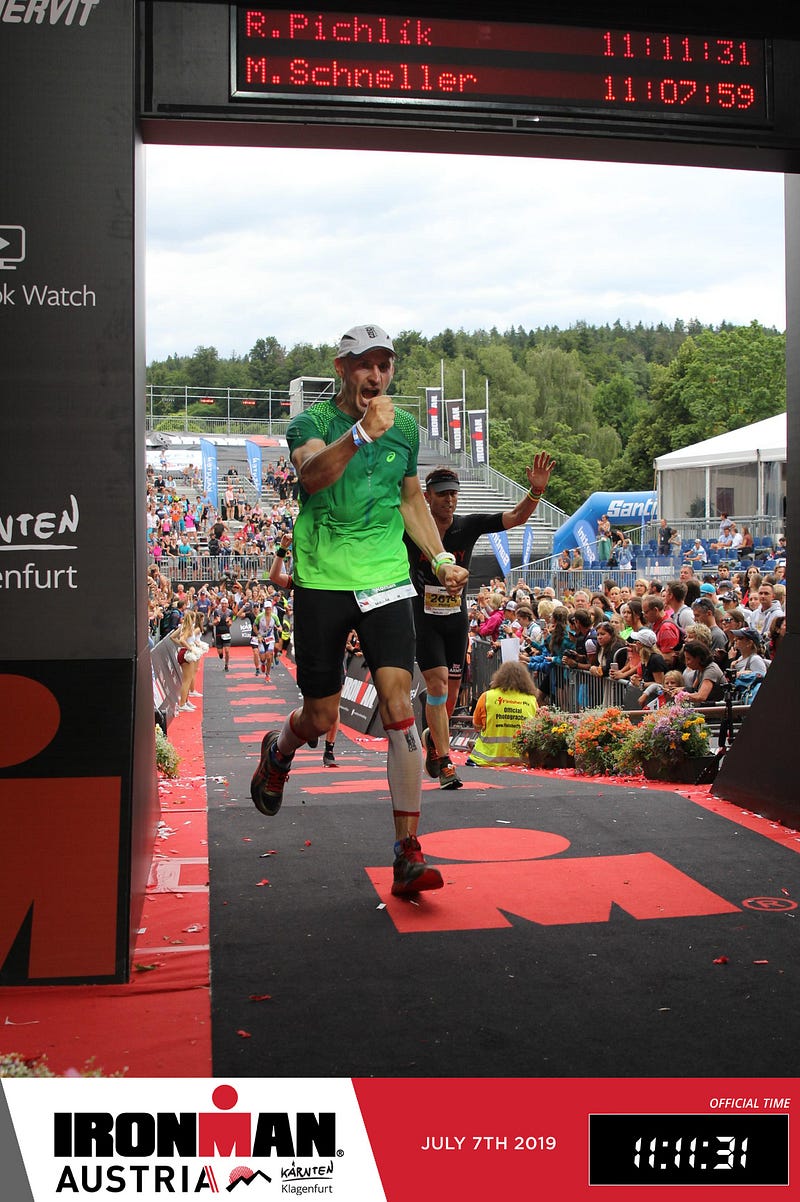
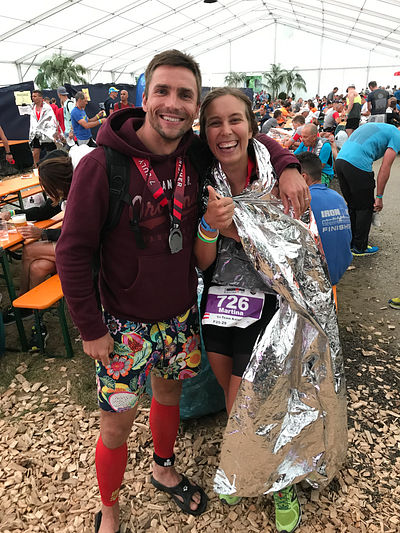
The run clock stopped after three hours, thirty minutes and a few seconds. The clock next to my name stopped at eleven hours and eleven minutes. I hadn’t broken eleven hours, but at the finish I was mainly pleased to have managed it without a major crisis and, above all, in one piece. I met up with Najmič in the Iron Dome. He’d finished in ten hours and fifty-six minutes. We threw our arms around each other like Red Army soldiers after raising the red flag over the Reichstag, and went for a beer. We’d earned it.
Thanks
None of what you’ve just read would have been possible without my family’s support. My biggest thanks go to Martina, who looked after our two boys while I was off swimming, running or cycling. Honza Falge guided my training and prepared me perfectly, so my thanks go to him too. If you want to get into triathlon, I can recommend his https://www.koa.cz.
Did you enjoy this article? Read about my other triathlon experiences.